More information are available at the poster. :)


 The Chinese has this saying, "身在福中不知幅 ” which is, "Living amidst blessings without knowing the blessings!"
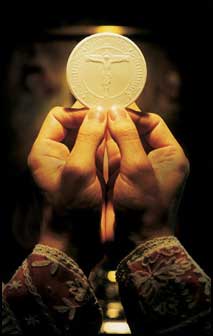
"I adore You, Lord and Creator, hidden in the Most Blessed Sacrament. I adore You for all the works of Your hands, that reveal to me so much wisdom, goodness and mercy, O Lord.
You have spread so much beauty over the earth and it tells me about Your beauty, even though these beautiful things are but a faint reflection of You, incomprehensible Beauty.
And although You have hidden Yourself and concealed your beauty, my eye, enlightened by faith, reaches You and my souls recognizes its Creator, its Highest Good, and my heart is completely immersed in prayer of adoration."
 Everyone of us has a Vocation, a common Vocation, a universal Vocation and that is the Vocation to Holiness.
Then Jesus said to them: "Amen, amen, I say unto you: unless you eat the flesh of the Son of man and drink his blood, you shall not have life in you. He that eats my flesh and drinks my blood has everlasting life, and I will raise him up in the last day. For my flesh is meat indeed, and my blood is drink indeed. He that eats my flesh and drinks my blood abides in me, and I in him. As the living Father has sent me and I live by the Father: so he that eats me, the same also shall live by me.This is the bread that came down from heaven. Not as your fathers ate manna and are dead. He that eats this bread shall live for ever."
Gospel of St.John 6: 53-58
--------------------------------------------------------------------
Recently, during the Corpus Christi Mass, my Bishop in his sermon made a very interesting point regarding the Eucharist. He said, "When we go up and receive Holy Communion it is not just us who are receiving Christ into our body but rather also Christ who is receiving us into His."
Now if we think about it in a more down to earth manner, if we in receiving Christ are being received into His body should we not be as clean ourselves as we would like when we receive our own food?
If you ever noticed; most of the time before our food is taken into ourselves it is cleansed first with water and then over a fire (or heat).
It is the same with us and Christ, before we let ourselves enter in union with Christs' body we should first receive absolution through the sacrament of confession( cleansing by water) and then followed by penance for our sins ( fire). In this way we will make good supplements in Christs' body and not end up as cancerous cells that causes nothing but hurt to our sweet Jesus.
Also in my observation and contemplations I cannot bear but wonder at the unsound judgment of Catholics these days. Why is it that when the Eucharist is exposed in the monstrance we show such reverence but when Christ is exposed before us during Holy Communion we treat Him so superficially? What is the difference between the contents of the monstrance and the communion bread?
Before I end I would like to also give you a little something to think about. Whenever you receive the Eucharist in Holy Communion just imagine yourself as a tabernacle, a monstrance, that is now housing the Blessed Sacrament. How we adore the Eucharist when it is exposed to us, should we not treat our own bodies in the same holiness and reverence? (How we dress: do we protect our modesty? How we speak: do we speak using foul, reckless and uncouth language? What we think and watch: are we constantly being filled with impurities in thought by what we watch or read? etc.)
St. Thomas Aquinas and St.Gemma Galgani Ora Pro Nobis.
Ad Jesum per Mariam

The Catechism of the Catholic Church on the Eucharist1324 The Eucharist is "source and summit of the Christian life." "The other sacraments, and indeed all ecclesiastical ministries and works of the apostolate, are bound up with the Eucharist and are oriented toward it. For in the blessed Eucharist is contained the whole spiritual good of the Church, namely Christ himself, our Pasch."
1325 "The Eucharist is the efficacious sign and sublime cause of that communion in the divine life and that unity of the People of God by which the Church is kept in being. It is the culmination both of God's action sanctifying the world in Christ and of the worship men offer to Christ and through him to the Father in the Holy Spirit."
1326 Finally, by the Eucharistic Celebration we already unite ourselves with the heavenly liturgy and anticipate eternal life, when God will be all in all.
1327 In brief, the Eucharist is the sum and summary of our faith: "Our way of thinking is attuned to the Eucharist, and the Eucharist in turn confirms our way of thinking."
Below is the Pange Lingua, written by St. Thomas Aquinas, who was given the task of composing hymns for the celebration of Corpus Christi, by Pope Urban IV. The better known Tantum Ergo (Down in adoration falling) actually forms the last two verses of the Pange Lingua.
In the solemn celebration of Pentecost we are invited to profess our faith in the presence and in the action of the Holy Spirit and to invoke his outpouring upon us, upon the Church and upon the whole world. Let us make our own, and with special intensity, the Church's invocation: "Veni, Sancte Spiritus! ( Come, Holy Spirit)"
It is such a simple and immediate invocation, but also extraordinarily profound, which came first of all from the heart of Christ. The Spirit, in fact, is the gift that Jesus asked and continually asks of his Father for his friends; the first and principal gift that he obtained for us through his Resurrection and Ascension in to heaven.
Today's Gospel passage, which has the Last Supper as its context, speaks to us of this prayer of Christ. The Lord Jesus said to his disciples: "If you love me, follow my commandments; and I will pray to the Father and he will give you another Paraclete who will remain with you forever" (John 14:15-16).
Here the praying heart of Jesus is revealed to us, his filial and fraternal heart. This prayer reaches its apex and its fulfillment on the cross, where Christ's invocation is one with the total gift that he makes of himself, and thus his prayer becomes, so to speak, the very seal of his self-giving for love of the Father and humanity: Invocation and donation of the Spirit meet, they interpenetrate, they become one reality. "And I will pray to the Father and he will give you another Paraclete who will remain with you forever." In reality, Jesus' prayer -- that of the Last Supper and the prayer on the cross -- is a single prayer that continues even in heaven, where Christ sits at the right hand of the Father. Jesus, in fact, always lives his priesthood of intercession on behalf of the people of God and humanity and so prays for all of us, asking the Father for the gift of the Holy Spirit.
The account of Pentecost in the Acts of the Apostles -- we listened to it in the first reading (Acts 2:1-11) -- presents the "new course" of the work that God began with Christ's resurrection, a work that involves man, history and the cosmos. The Son of God, dead and risen and returned to the Father, now breathes with untold energy the divine breath upon humanity, the Holy Spirit. And what does this new and powerful self-communication of God produce? Where there are divisions and estrangement he creates unity and understanding. The Spirit triggers a process of reunification of the divided and dispersed parts of the human family; persons, often reduced to individuals in competition or in conflict with each other, reached by the Spirit of Christ, open themselves to the experience of communion, can involve them to such an extent as to make of them a new organism, a new subject: the Church. This is the effect of God's work: unity; thus unity is the sign of recognition, the "business card" of the Church in the course of her universal history. From the very beginning, from the day of Pentecost, she speaks all languages. The universal Church precedes the particular Churches, and the latter must always conform to the former according to a criterion of unity and universality. The Church never remains a prisoner within political, racial and cultural confines; she cannot be confused with states not with federations of states, because her unity is of a different type and aspires to transcend every human frontier.
From this, dear brothers, there derives a practical criterion of discernment for Christian life: When a person or a community, limits itself to its own way of thinking and acting, it is a sign that it has distanced itself from the Holy Spirit. The path of Christians and of the particular Churches must always confront itself with the path of the one and catholic Church, and harmonize with it. This does not mean that the unity created by the Holy Spirit is a kind of homogenization. On the contrary, that is rather the model of Babel, that is, the imposition of a culture of unity that we could call "technological." The Bible, in fact, tells us (cf. Genesis 11:1-9) that in Babel everyone spoke the same language. At Pentecost, however, the Apostles speak different languages in such a way that everyone understands the message in his own tongue. The unity of the Spirit is manifested in the plurality of understanding. The Church is one and multiple by her nature, destined as she is to live among all nations, all peoples, and in the most diverse social contexts. She responds to her vocation to be a sign and instrument of unity of the human race (cf. Lumen Gentium, 1) only if she remains free from every state and every particular culture. Always and in every place the Church must truly be catholic and universal, the house of all in which each one can find a place...
...A Father of the Church, Origen, in one of his homilies on Jeremiah, reports a saying attributed to Jesus, not contained in the sacred Scriptures but perhaps authentic, which he puts thus: "Whoever is near me, is near the fire" (Homilies on Jeremiah, L. I [III]). In Christ, in fact, there is the fullness of God, who in the Bible is compared to fire. We just observed that the flame of the Holy Spirit burns but does not destroy. And nevertheless it causes a transformation, and it must for this reason consume something in man, the waste that corrupts him and hinders his relations with God and neighbor.
This effect of the divine fire, however, frightens us, we are afraid of being "burned," we prefer to stay just as we are. This is because our life is often formed according to the logic of having, of possessing and not the logic of self-giving. Many people believe in God and admire the person of Jesus Christ, but when they are asked to lose something of themselves, then they retreat, they are afraid of the demands of faith. There is the fear of giving up something nice to which we are attached; the fear that following Christ deprives us of freedom, of certain experiences, of a part of ourselves. On one hand, we want to be with Jesus, follow him closely, and, on the other hand, we are afraid of the consequences that this brings with it.
Dear brothers and sisters, we always need to hear the Lord Jesus tell us what he often repeated to his friends: "Be not afraid." Like Simon Peter and the others we must allow his presence and his grace to transform our heart, which is always subject to human weakness. We must know how to recognize that losing something, indeed, losing ourselves for the true God, the God of love and of life, is in reality gaining ourselves, finding ourselves more fully. Whoever entrusts himself to Jesus already experiences in this life peace and joy of heart, which the world cannot give, and it cannot even take it away once God has given it to us.
The above article are little snippets taken from Pope Benedict XVIs' homily for the Solemnity of Pentecost
The full homily can be found here
----------------------------------------------------------------------------------
Dear Brothers and Sisters,
We just experienced the Feast of Pentecost. I used the word experience because since Pentecost is also known as the birthday of the Church I believe some of us are also experiencing a minor rebirth in our own living situations (turning new a new chapter in life); some through enrollment in this Poly and some through graduation and some through other events that escape my mind at the moment. Through these significant changes and experiences in our lives (however minor it may be) we must always look to the second helper the promised Paraclete that Christ has sent to us for guidance, strength and continuous renewal. Renewal to? our thoughts for one, our behaviors, our way of living life, our daily practices, our approach towards each other, and most importantly our earnestness in making Christ the center of our lives because and only because we love him and nothing else.
The above 'cut-up' of the our dear Pontiffs' Homily explains to us (in brief detail here) how exactly we can do this and if you are attentive you will find it marginally familiar with what Fr. Alex was trying to explain to us today remember? the four steps of getting closer to God?
If you are lazy to read the article I bid you at least just go through those that I highlighted in red, if you are zealous (now I'm speaking to the leaders) click the link above!
With that I leave you dudes and dudettes in the merciful unconditional love of the Father, the fraternal unconditional love of Christ and the guiding unconditional love of the Holy Spirit.
(Loving and Missing you guys.)
Ad Jesum Per Mariam.